
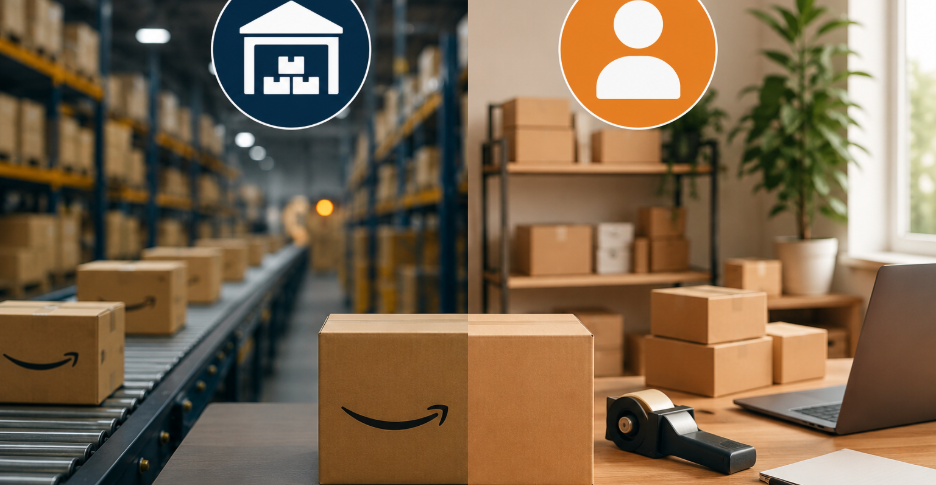
Key Takeaways
- Amazon FBA and FBM give Canadian sellers different ways to manage inventory, shipping, and customer orders.
- FBA can reduce the day-to-day fulfillment workload, while FBM gives sellers greater control over storage, packing, and delivery.
- Product size, order volume, margins, storage needs, and operational capacity should all factor into the decision.
- A third-party logistics provider can support either strategy by handling storage, prep, packing, and inventory management.
- For businesses operating in the Greater Toronto Area, local warehousing and fulfillment support can make FBM or hybrid fulfillment more practical.
Choosing how to fulfill Amazon orders is not simply a matter of picking up the option that sounds easier. For Canadian sellers, the decision can affect storage costs, delivery operations, inventory control, and how much time the business spends on fulfillment.
Amazon’s two main options are Fulfillment by Amazon (FBA) and Fulfilled by Merchant (FBM). With FBA, Amazon stores eligible inventory and handles picking, packing, shipping, customer service, and returns. With FBM, the seller manages fulfillment directly or works with a third-party logistics provider. Amazon also allows sellers to use both methods for different products.
When Does FBA Make Sense?
FBA can be a practical choice for sellers who want to reduce the amount of day-to-day fulfillment work they handle themselves. Instead of maintaining the entire order fulfillment operation, sellers send inventory into Amazon’s fulfillment network and let Amazon handle orders once they are placed.
Sending inventory to Amazon does not eliminate every logistical task. Products still need to be received, inspected, labeled, packaged, and prepared correctly before they reach an Amazon fulfillment centre.
That’s where a Amazon FBA preparation service can help. A prep provider can receive inventory, inspect products, apply required labels, package items, manage storage, and coordinate shipments to Amazon.
When Is FBM the Better Option?
FBM gives sellers more direct control over inventory and fulfillment. Instead of sending all stock into Amazon’s network, the business, or its logistics partner, stores inventory and ships orders to customers.
This approach can make sense for products with lower sales volumes, larger dimensions, specialized packaging requirements, or margins that make Amazon’s fulfillment costs less attractive.
It can also be useful when a seller already has a warehouse infrastructure. A business does not necessarily need to build that operation from scratch.
Working with an FBA prep center or third-party fulfillment provider can provide access to warehousing, inventory management, and order processing without requiring the seller to manage every physical task internally.
FBA vs. FBM: What Should You Consider?
There is no universal winner. The right choice depends on the way your business operates.
Product Size and Type
Small, fast-moving products may be easier to place into FBA, while oversized or specialized products may make more sense to fulfill directly.
Order Volume
High order volumes can make outsourcing fulfillment attractive. If your business is processing only a small number of orders, however, managing fulfillment internally may still be practical.
Storage Requirements
Think beyond the cost of storing inventory. Consider how much space you need, how quickly products move, and whether you need short- or long-term storage between shipments.
Control and Flexibility
FBM gives sellers more control over packaging, inventory location, and shipping processes. FBA reduces that operational burden but places more of the fulfillment process within Amazon’s network.
Location
For businesses operating in Ontario and the GTA, having inventory close to suppliers, customers, and transportation networks can simplify fulfillment. RGX Group operates warehouses in Etobicoke, Mississauga, and Brampton, with integrated storage, pick-and-pack, and eCommerce fulfillment capabilities.
What About a Hybrid Approach?
You do not necessarily have to choose one method for every product.
Some sellers use FBA for their faster-moving products while keeping other inventory with a third-party fulfillment provider. This can provide more flexibility when products have different sales patterns, storage requirements, or fulfillment costs.
For GTA businesses, pick and pack services in GTA can support this type of setup by allowing inventory to be stored and individual customer orders to be processed without sending every unit to Amazon.
Final Thoughts
The ideal fulfillment strategy should be determined by your products, volume of orders, profit margins, storage needs, and available resources. Evaluate the entire fulfillment process, not just individual costs or fees.
For Canadian businesses that need local warehousing, inventory management, or FBA prep services, RGX Group provides fulfillment and logistics support from its GTA facilities, helping sellers manage inventory before it moves to Amazon or directly to customers.
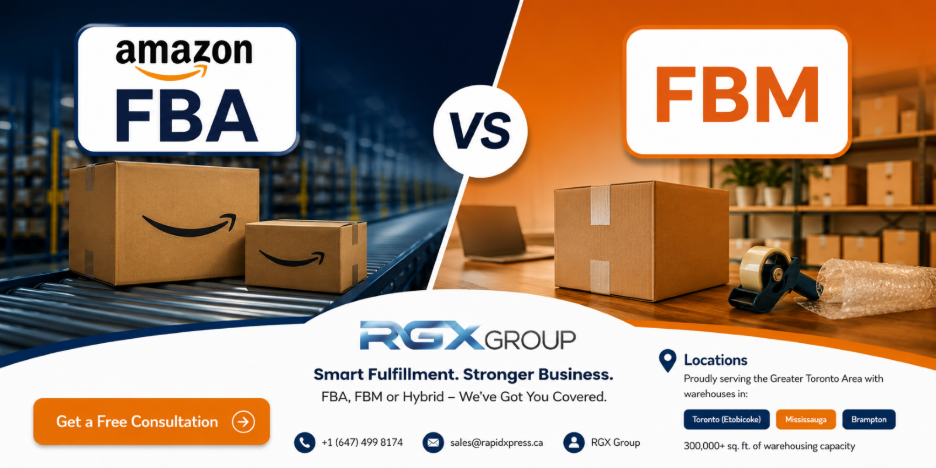
FAQs
- Is FBA better than FBM for Canadian Amazon sellers?
Not necessarily. FBA can be useful for sellers who want Amazon to handle storage and order fulfillment, while FBM may provide greater control over inventory, packaging, and shipping. The better option depends on product characteristics, sales volume, margins, and operational capacity.
- What does an Amazon FBA preparation service include?
An Amazon FBA preparation service typically includes receiving inventory, inspecting products, labeling, packaging, sorting, and preparing shipments to meet Amazon’s requirements. The exact services depend on the provider and the seller’s product requirements.
- Can I use FBA and FBM at the same time?
Yes. Amazon sellers can use different fulfillment methods for different products or circumstances. A hybrid approach can be useful when some products are better suited to FBA while others are more cost-effective or practical to fulfill through a third-party provider.
- Why use an FBA prep center in Canada?
An FBA prep center can give Canadian sellers access to local inventory handling and preparation without requiring them to manage every warehouse task themselves. This can be particularly useful for businesses selling through Amazon while maintaining inventory in Ontario or the GTA.
- Are pick and pack services useful for GTA businesses?
They can be. Pick and pack services in GTA allow a fulfillment provider to store inventory, pick individual products when orders arrive, and prepare them for shipment, helping businesses reduce the need to manage these processes internally.

