
Key Takeaways:
- Compare receiving, preparation, storage, packaging, and shipping costs before choosing a provider.
- Verify Amazon FBA labeling and packaging requirements for your products.
- Assess turnaround times, inventory tracking, and cross-border logistics.
- Use a cost comparison and trial shipment to evaluate service quality.
- Choose an FBA prep partner that can accommodate changes in inventory volume.
While the selling process through Amazon FBA is easy, inventory needs to be prepared, labeled, packaged, and sent properly. As a company expands, you could face challenges in handling all these tasks in-house, especially if products need special handling, or if there are shipments crossing international boundaries.
A reliable FBA prep center Canada sellers choose should combine accurate inventory handling, transparent pricing, and dependable shipment coordination. Here is how to compare providers and determine which one fits your operation.
1. Understand What an FBA Prep Center Does
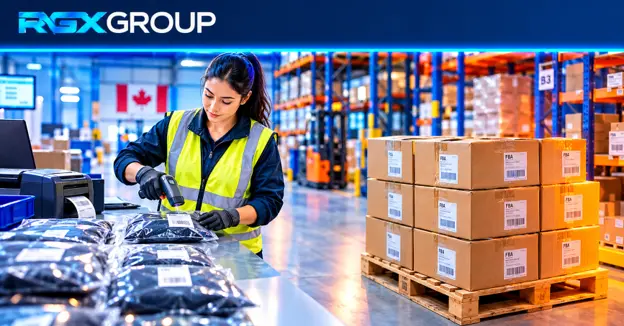
An Amazon FBA prep center receives inventory and prepares it for shipment to Amazon fulfillment centers. Services may include product inspection, FNSKU labeling when required, poly bagging, protective wrapping, bundling, and carton preparation.
The right services depend on your products. Fragile items may need additional protection, while multipacks require packaging that keeps the units together.
Amazon ended its Canadian FBA prep and item-labeling services on July 1, 2026. Its official announcement states that products must be prepared and labeled before being sent to its facilities. The change applies to inventory entering the Canada FBA service, including eligible inventory routed through Amazon SEND and the Supply Chain Portal.
Third-party preparation is one option, but sellers remain responsible for understanding the requirements that apply to their inventory.
2. Check Amazon FBA Experience
Not every warehouse provides the specialized FBA prep services Canada sellers need. Ask prospective providers about their experience with product labeling, packaging specifications, inventory checks, and shipment documentation.
Before choosing an Amazon FBA prep center, confirm that it can provide:
- Receiving checks and damage reporting.
- FNSKU labeling when applicable.
- Protective packaging, poly bagging, and bundling.
- Inventory records and shipment updates.
Amazon’s packaging and prep guidance outlines requirements for packaging, barcodes, and specific product types. Ask providers how they keep their procedures aligned with current Seller Central instructions, which should take precedence over general advice.
3. Compare Total Costs, Not Just Prep Fees
The lowest advertised rate may not deliver the lowest overall cost. Receiving, storage, special packaging, returns handling, and outbound freight can all affect your final bill.
When comparing the best FBA prep service for your business, request a detailed rate card and calculate the cost of a typical shipment.
Compare equivalent services across providers. Also ask about minimum monthly spending, additional handling fees, and charges for returns or unexpected work.
4. Evaluate Location and Logistics
Location can affect freight costs and transit times. Sellers considering FBA prep Toronto may find an Ontario facility convenient if their suppliers or inventory are concentrated in the Greater Toronto Area.
Companies operating in BC or Alberta should make a comparison of facilities in their region versus other parts of Canada. A provider in the vicinity may not be a cheaper option if the total costs of their preparation rates or shipments are higher.
Request schedules, pallets, peak season capacity and carrier coordination. Get quotes for processing and transportation time to better plan for replenishment.
5. Confirm Cross-Border Capabilities
If you sell in both Canada and the United States, check whether the provider can prepare inventory for U.S. Amazon fulfillment centers and coordinate the required transportation.
Before sending stock, discuss shipment papers, customs assistance, duties and taxes, and duties of the importer of record. Such arrangements will vary by shipment and the parties involved, so be sure to specify exactly who will be responsible for what.
Effective FBA prep logistics should establish who books transportation, prepares documentation, monitors shipment progress, and communicates delays.
6. Verify Inventory Tracking and Provider Capabilities
A dependable prep center should be able to confirm what it receives, record discrepancies, and provide updates as inventory moves through preparation and dispatch.
RGX Group provides FBA preparation services that include receiving and inspection, labeling, packaging, storage, and inventory management. The company also offers warehousing and fulfillment services, with facilities in Toronto, Mississauga, and Brampton.
Its FBA prep center services page describes its preparation procedure in addition to its services. Please contact RGX Group for up-to-date prices, turnaround, destination and any product specific restrictions prior to purchasing.
7. Test the Service Before Scaling
A provider may look suitable on paper but still fall short on communication or handling accuracy. Where possible, begin with a manageable shipment and assess the results before committing a larger share of your inventory.
Track a few practical measures:
- Receiving accuracy: Did the recorded quantities match the shipment?
- Preparation quality: Were labels and packaging applied correctly?
- Turnaround: Did inventory get done in the time frame agreed upon?
- Communication: Do discrepancies/delays in communication get reported promptly?
- Cost consistency: Did the final invoice match the agreed rate card?
Also check the length of the contract, minimum fees, cancellation policy and per-volume price. The best FBA prep company should be cost-effective, have clearly established processes, and services that can adjust with your organization.
Frequently Asked Questions:
Q. What is an Amazon FBA prep center, and do I need one in Canada?
Ans: An Amazon FBA prep center prepares inventory for Amazon fulfillment centers through services such as inspection, labeling, and packaging. Canadian sellers may benefit from outsourcing when preparation requirements or order volumes become difficult to manage in-house.
Q. How much do Canadian FBA prep centers typically charge per unit?
Ans: It depends on the size of the products, their preparation requirements, the volume of products being shipped, storage facilities and transportation. Get an itemized estimate and compare the price per item, instead of just the preparation fee.
Q. Can a Canadian FBA prep center handle cross-border shipments to U.S. Amazon fulfillment centers?
Ans: Some providers may be able to arrange shipping to U.S. fulfillment centers. Make sure they understand their carrier options, customs support, documentation and duties/duty clearance/taxes.
Q. Do Canadian FBA prep centers require long-term contracts or minimum monthly fees?
Ans: Some will provide pay-as-you-go options, and others will need a smaller amount of spending or longer term commitments. Before signing, check out the rate card, cancellation policy, storage fees and other handling fees.

